
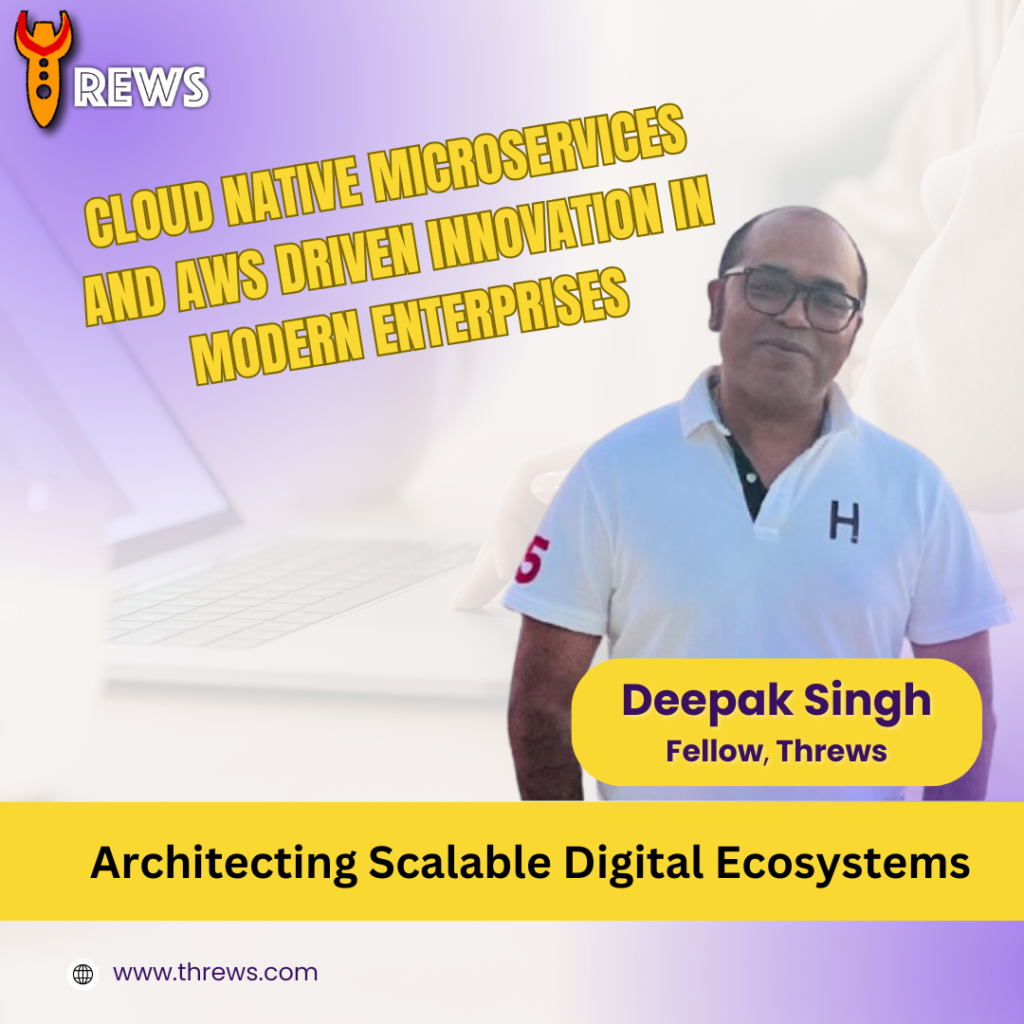
Architecting Scalable Digital Ecosystems: Cloud Native Microservices and AWS Driven Innovation in Modern Enterprises
Written by Deepak Singh
“The views expressed are my own.”
Modern enterprises are under constant pressure to deliver scalable, resilient, and high-performance digital solutions. Traditional monolithic systems can no longer keep pace with rapidly evolving business needs. Cloud-native architectures, microservices, and AWS have emerged as the foundation for building agile, future-ready digital ecosystems.
With nearly two decades of experience in software engineering and solution architecture, I have seen firsthand how the right architectural choices can transform not just systems, but entire organizations.
The Shift to Cloud-Native Thinking
Cloud-native is not merely about moving applications to the cloud; it is a mindset focused on scalability, resilience, and continuous innovation. Cloud-native systems are designed to leverage elasticity, automation, and managed services from the outset. This approach allows enterprises to respond quickly to changing demands while maintaining operational stability.
By adopting cloud-native principles, organizations reduce infrastructure complexity and shift focus from maintenance to innovation.
Microservices as the Backbone of Scalability
Microservices architecture breaks complex applications into smaller, independently deployable services. Each service is designed around a specific business capability, enabling teams to develop, test, and deploy faster.
This architectural style enhances fault isolation, improves scalability, and supports parallel development. When combined with DevOps practices, microservices enable continuous delivery pipelines that accelerate time-to-market without sacrificing quality or reliability.
AWS as an Innovation Enabler
AWS provides a rich ecosystem of services that support modern application development. From compute and storage to managed databases, messaging, and serverless technologies, AWS enables architects to design highly available and secure systems at scale.
Services such as container orchestration, event-driven architectures, and infrastructure as code allow enterprises to automate deployments, optimize costs, and ensure consistent environments across development, testing, and production.
Building Resilience and Security by Design
Scalability without resilience is incomplete. Cloud-native architectures emphasize redundancy, automated recovery, and observability. Designing for failure ensures that systems remain available even when individual components fail.
Security must also be embedded into the architecture from day one. Identity management, encryption, network isolation, and continuous monitoring are essential to protecting enterprise workloads in the cloud. A well-architected system balances performance, security, and cost efficiency.
The Role of the Solution Architect
A solution architect bridges business objectives and technical execution. Beyond selecting technologies, the role involves defining long-term architectural vision, guiding development teams, and ensuring alignment with organizational goals.
Clear communication, strong design principles, and continuous learning are critical in an environment where technologies evolve rapidly.
Looking Ahead
The future of enterprise technology lies in scalable, modular, and cloud-driven ecosystems. Organizations that invest in microservices, cloud platforms, and modern development practices will be better equipped to innovate, adapt, and grow sustainably.
As a Threws Fellow, I strongly believe in sharing knowledge, mentoring professionals, and contributing to a global technology community focused on excellence and responsible innovation. Architecture is not just about systems; it is about enabling people and businesses to succeed in a digital-first world.
About the Author
Deepak Singh is a Principal Solution Architect with with over two decades of experience in enterprise-scale AI, cloud, and cybersecurity architectures, specializing in secure, governed, and scalable systems for highly regulated environments.