
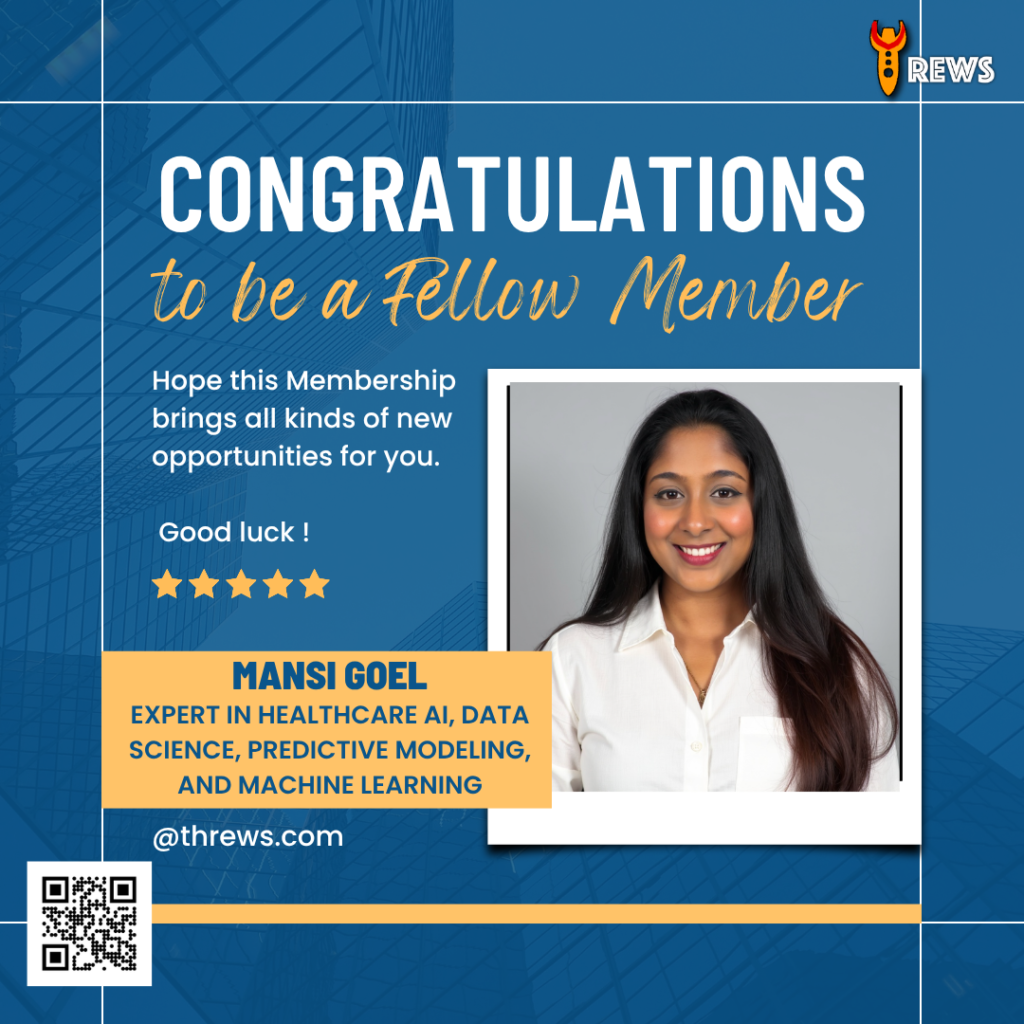
Artificial intelligence and data science are transforming modern healthcare by enabling healthcare professionals and organizations to analyze complex medical data, identify patterns, and develop predictive tools that can support clinical decision-making. As healthcare systems generate increasingly large volumes of electronic health record data, the ability to transform this information into meaningful and actionable insights has become particularly important.
Mansi Goel is a Data Scientist at Lucem Health, where she works at the intersection of healthcare artificial intelligence, predictive modeling, and clinical data analytics. Her work focuses on using large-scale electronic health record (EHR) datasets to support the development and operationalization of disease risk stratification models designed to identify patients who may be at risk of specific health conditions.
With a strong academic foundation in data science and mathematics, Mansi combines analytical expertise, machine learning knowledge, and cross-functional collaboration to contribute to AI-driven healthcare solutions. Her professional interests reflect a broader commitment to translating advances in artificial intelligence into practical applications that can support earlier identification of disease risk and more informed healthcare decisions.
Academic Excellence in Data Science and Mathematics
Mansi Goel’s academic background provides a strong foundation for her work in machine learning, statistical analysis, and healthcare data science.
She earned a Master of Science in Engineering in Data Science from Johns Hopkins University. Her postgraduate education strengthened her understanding of data-driven methods, analytical modeling, and the application of computational techniques to complex problems.
Prior to this, she completed a Bachelor of Science in Mathematics with a minor in Computer Science from Shiv Nadar University
The combination of mathematics and computer science is particularly valuable in data science. Mathematical reasoning supports statistical analysis and model formulation, while computer science provides the computational tools required to process data, develop algorithms, and implement analytical solutions.
This interdisciplinary academic foundation complements Mansi’s professional focus on predictive healthcare analytics and responsible machine learning.
Healthcare Artificial Intelligence at Lucem Health
In her role at Lucem Health, Mansi contributes to the development and implementation of AI-driven healthcare solutions using large-scale electronic health record data.
EHR systems contain extensive information about patients’ medical histories, diagnoses, clinical encounters, and other healthcare-related observations. When analyzed appropriately, these datasets can help researchers and healthcare technology teams investigate patterns associated with disease risk and develop predictive models for further clinical evaluation.
Mansi’s work involves structuring and analyzing healthcare datasets using Python, SQL, and cloud-based data platforms. These activities support the development and operationalization of disease risk stratification models across multiple clinical areas.
Her professional focus includes three important areas:
- Cardiac arrhythmias: Supporting analytical work related to identifying patterns associated with abnormal heart rhythms.
- Liver disease: Contributing to data-driven approaches for assessing disease risk and supporting potential earlier identification.
- Type 1 diabetes: Working with healthcare data to support predictive risk modeling in another important clinical domain.
These applications illustrate the potential of healthcare AI to help identify patients who may benefit from further assessment. Predictive models are decision-support tools, however, and their clinical value depends on appropriate validation, responsible implementation, and evaluation within real-world healthcare settings.
Predictive Modeling and Clinical Data Science
Predictive modeling is an important component of modern healthcare analytics. By examining relationships within clinical datasets, machine learning models can estimate the likelihood of future events or identify patterns that may warrant additional investigation.
Mansi’s work in healthcare data science involves preparing and structuring EHR datasets for predictive modeling and supporting the operationalization of disease risk stratification solutions.
This type of work requires more than selecting a machine learning algorithm. It involves understanding the underlying data, defining suitable patient cohorts, developing relevant features, evaluating model performance, and considering how model outputs will be used in clinical workflows.
Her stated experience spans several aspects of the clinical AI development lifecycle, including:
- Patient cohort design and data preparation.
- Feature engineering and predictive model development.
- Model evaluation and performance assessment.
- Model explainability and fairness assessment.
- Considerations for real-world deployment and operational integration.
These activities are important for building healthcare AI systems that are not only analytically effective but also suitable for careful evaluation in complex clinical environments.
Responsible Machine Learning and Trustworthy Clinical AI
Healthcare AI presents distinctive responsibilities because predictive outputs can influence clinical attention, follow-up decisions, and the allocation of healthcare resources.
Developing responsible clinical AI therefore requires attention to model performance, data quality, explainability, fairness, privacy, and the limitations of automated predictions.
Mansi’s professional interests include responsible machine learning and the evaluation of AI systems for healthcare applications. Her experience with explainability and fairness assessment aligns with the wider need to understand how predictive models behave across different populations and clinical contexts.
Several principles are especially important in this domain.
Model evaluation: Models should be assessed using metrics appropriate to their intended clinical purpose, including measures of discrimination, calibration, and error rates where relevant.
Explainability: Understanding which variables influence predictions can help technical teams investigate model behavior and communicate limitations to stakeholders.
Fairness assessment: Evaluating model performance across relevant patient groups can help identify potential disparities and guide further investigation.
Real-world implementation: A model’s usefulness depends not only on its technical performance but also on how it integrates with clinical processes, data systems, and healthcare professionals’ workflows.
These considerations are essential for developing trustworthy AI systems that support, rather than replace, appropriate clinical judgment.
Translating Data Insights into Product Strategy and Operations
Successful healthcare AI initiatives require coordination among data scientists, engineers, clinical stakeholders, and product teams. Analytical findings must be translated into product requirements, operational plans, and workflows that can function within real-world environments.
Alongside her technical responsibilities, Mansi contributes to product strategy and operational planning by translating analytical findings into insights that inform feature prioritization, clinical use cases, and scalable implementation of disease detection programs.
Her responsibilities also include supporting cross-functional execution through Jira backlog management, user story development, sprint coordination, and Confluence documentation.
This combination of technical and operational work highlights the importance of connecting data science with product development. Effective collaboration helps teams clarify requirements, coordinate implementation, document processes, and maintain alignment between analytical objectives and operational needs.
Her experience reflects the value of professionals who can work across both technical and organizational dimensions of healthcare innovation.
Technical Expertise in Data Science, Machine Learning, and Cloud Analytics
Mansi’s technical toolkit spans programming, statistical analysis, machine learning, visualization, and cloud-based data processing.
Her stated skills include:
- Programming and data analysis: Python, NumPy, Pandas, and SQL.
- Machine learning: Scikit-learn, regression, classification, and clustering.
- Data visualization: Matplotlib, Seaborn, and Tableau.
- Cloud and analytics platforms: Microsoft Azure, Synapse Analytics, Google Cloud BigQuery, Vertex Workbench, and Colab Enterprise.
- Research and development tools: GitHub and Jupyter Notebook.
- Product and project collaboration: Jira, Confluence, Agile methodologies, sprint planning, and retrospectives.
These technologies support different stages of a data science workflow, from preparing datasets and exploring patterns to developing models, communicating results, and coordinating implementation.
In healthcare settings, such capabilities can be especially useful when working with complex data structures and collaborating with multidisciplinary teams to translate analytical work into practical solutions.
Research, Peer Review, Judging, and Mentorship
In addition to her industry work, Mansi actively contributes to the broader data science community through research, peer review, judging, and mentorship.
These activities create opportunities to engage with emerging ideas, evaluate technical work, exchange knowledge, and support the development of other professionals.
Research and peer review contribute to the evaluation and communication of scientific and technical findings. Judging can provide opportunities to assess projects, innovation, and problem-solving approaches, while mentorship helps individuals develop their skills and navigate technical challenges.
Her involvement in these areas complements her professional focus on healthcare AI and data science, reflecting an interest in knowledge-sharing and the wider development of the technology community.
Specific publications, reviewing appointments, judging panels, and mentorship initiatives can be added to her professional profile as verified details become available.
The Future of Healthcare AI: From Predictive Insights to Practical Impact
Healthcare artificial intelligence continues to evolve, with growing interest in using predictive analytics to support earlier risk identification, more efficient workflows, and better-informed clinical decisions.
Realizing this potential requires a combination of high-quality data, appropriate model development, rigorous evaluation, responsible governance, and collaboration between technical and clinical stakeholders.
Professionals working across these areas help address the practical challenges involved in moving AI from experimental development toward responsible real-world implementation.
Mansi Goel’s work in EHR analytics, disease risk stratification, machine learning evaluation, and cross-functional product execution reflects several of these priorities. Her multidisciplinary background in mathematics, computer science, and data science provides a foundation for contributing to this evolving field.
As healthcare organizations continue exploring AI-driven solutions, the integration of analytical rigor with operational awareness will remain important for developing systems that are useful, reliable, and appropriate for their intended clinical settings.
Mansi Goel is a healthcare data science professional whose work focuses on applying artificial intelligence and predictive modeling to complex healthcare challenges.
As a Data Scientist at Lucem Health, she contributes to the analysis of electronic health record data and the development and operationalization of disease risk stratification models involving cardiac arrhythmias, liver disease, and Type 1 diabetes.
Her academic qualifications from Johns Hopkins University and Shiv Nadar University, combined with her technical skills and experience in cross-functional product operations, provide a strong foundation for work at the intersection of data science and healthcare innovation.
Through her interests in responsible machine learning, model evaluation, and real-world implementation, Mansi exemplifies the multidisciplinary approach required to translate advances in artificial intelligence into meaningful healthcare applications.