
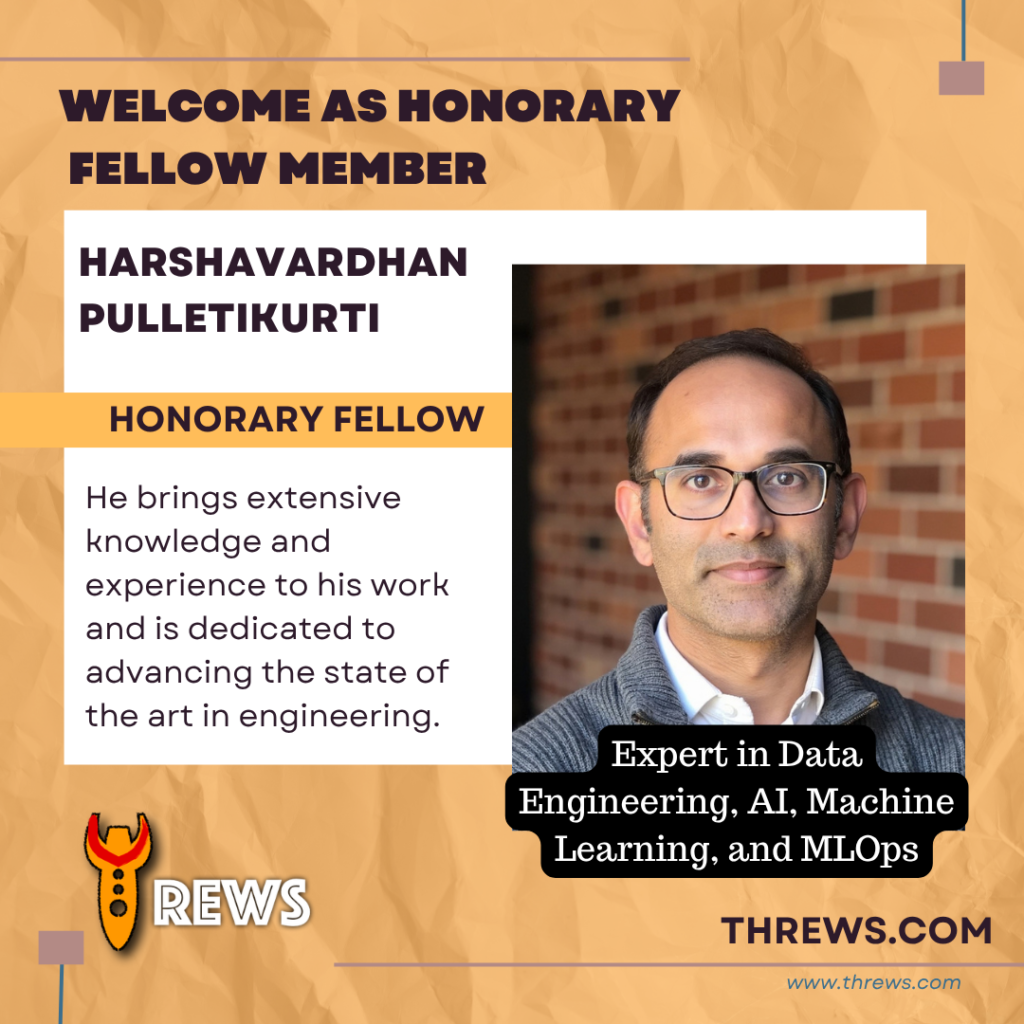
In an increasingly data-driven digital economy, organizations need scalable data infrastructure, intelligent analytics, and production-ready artificial intelligence to remain competitive. Harshavardhan Pulletikurti, a seasoned data engineering and AI architecture professional, brings more than 20 years of experience in enterprise data platforms, marketing technology, machine learning infrastructure, and advanced analytics.
Based in Seattle, Washington, Harshavardhan has developed expertise at the intersection of data engineering, AI-driven decision-making, marketing data science, and enterprise technology modernization. His professional journey spans prominent organizations, including Salesforce, lululemon, Publicis, Cognizant, Microsoft India, Invesco, and iSOFT.
Through his work in enterprise architecture, data platform modernization, and machine learning operations, he focuses on building reliable, governed, and scalable data ecosystems that enable organizations to transform complex information into actionable business intelligence.
Professional Leadership in Data Engineering and AI Architecture
Harshavardhan Pulletikurti currently serves as a Principal Data Engineer in Marketing Decision Sciences at Salesforce, where his work focuses on data engineering strategy, enterprise architecture, and the development of AI-ready data foundations.
His responsibilities include modernizing data infrastructure, establishing engineering standards, and supporting the evolution of marketing analytics toward conversational and agentic AI capabilities. By aligning data architecture with business objectives, he contributes to the development of systems designed to support intelligent targeting, marketing measurement, personalization, and automated decision-making.
A key aspect of his approach is the integration of data governance, semantic modeling, and machine learning infrastructure. These capabilities help create trusted data environments in which analytics teams and AI systems can access consistent information and generate more meaningful insights.
His experience demonstrates the importance of connecting enterprise data architecture with practical business requirements, particularly in organizations managing complex, high-volume marketing and customer data.
Expertise in Enterprise Data Platforms and Lakehouse Architecture
Modern enterprises require data platforms that can accommodate diverse workloads, support real-time processing, and maintain consistent standards for quality and governance. Harshavardhan has substantial experience designing and modernizing enterprise data ecosystems using contemporary data engineering technologies and architectural patterns.
During his tenure as a Staff Solutions Architect for Data Platform and Martech at lululemon from 2023 to 2025, he led the redesign of enterprise data infrastructure supporting global customer relationship management, marketing technology, and digital analytics.
His work included implementing a medallion lakehouse architecture using Databricks, developing streaming data products, and adopting open table formats such as Apache Iceberg.
These initiatives supported improved data accessibility, reduced duplication, and more flexible integration between storage and compute environments. His work on composable customer data platforms also helped replace legacy monolithic systems with a more flexible architecture, delivering approximately $500,000 in annual cost savings.
Additionally, his implementation of centralized machine learning feature infrastructure reduced feature redundancy by 40% and accelerated model deployment cycles by 30%.
These achievements reflect his ability to combine technical architecture with measurable improvements in engineering efficiency, platform flexibility, and operational cost management.
Advancing Artificial Intelligence and Machine Learning Infrastructure
Artificial intelligence requires more than sophisticated algorithms. Successful enterprise AI depends on reliable data pipelines, reusable features, continuous monitoring, and robust production infrastructure.
Harshavardhan’s background in machine learning engineering and data science infrastructure enables him to address these foundational requirements. His experience includes developing feature engineering pipelines, supporting model deployment, implementing model monitoring, and establishing automated workflows for model retraining and evaluation.
At Salesforce, his work includes building feature store capabilities using AWS SageMaker Feature Store and Snowflake, supporting point-in-time-correct feature retrieval and consistency between online and offline environments.
He has also worked on MLOps observability, including feature drift detection using Population Stability Index (PSI) and Kullback–Leibler (KL) divergence. Such monitoring techniques help teams identify changes in incoming data distributions and evaluate whether production machine learning systems continue to operate reliably.
His broader technical expertise includes propensity modeling, customer lifetime value prediction, time-series forecasting, experimental design, statistical inference, and machine learning lifecycle management.
By connecting data engineering with production machine learning, he helps establish the infrastructure needed to operationalize AI beyond experimental environments.
Building Data Foundations for Conversational and Agentic AI
The development of large language models and agentic AI systems is creating new requirements for enterprise data architecture. AI applications need access to reliable business context, consistent definitions, and governed data sources to support useful reasoning and decision-making.
Harshavardhan’s current work addresses these requirements through semantic data layers, business ontologies, embedding generation pipelines, and vector index infrastructure.
His approach includes organizing marketing concepts such as campaigns, audiences, channels, and conversions into structured semantic models. These foundations can help AI applications interpret business terminology consistently, retrieve relevant information, and interact with enterprise data more effectively.
His experience in semantic search and personalization also supports applications involving product affinity, recommendation relevance, and marketing activation across multiple channels.
This combination of enterprise data engineering, semantic architecture, and MLOps positions his work within an important area of technological development: building trustworthy data infrastructure for AI-enabled business operations.
Marketing Data Science and Customer Intelligence
Harshavardhan has an extensive background in marketing data science, particularly in customer segmentation, predictive modeling, personalization, and marketing measurement.
From 2017 to 2023, he worked as a Lead Data Scientist and ML Platform Engineer across Publicis organizations, including Epsilon, Media, and Razorfish. His work involved developing machine learning data platforms and feature engineering infrastructure for enterprise clients.
He designed pipelines using demographic, behavioral, and transactional data to support audience segmentation, propensity scoring, customer lifetime value modeling, and attribution analysis.
His reported professional achievements include:
- 15% increase in high-value response rates through audience segmentation infrastructure.
- More than 30% expansion in prospect pools through reusable audience segments and look-alike scoring.
- 15–20% improvement in marketing budget allocation efficiency through lifetime value and multi-touch attribution models.
- 15–25% improvement in campaign lift through predictive models supporting propensity, churn, upsell, and cross-sell applications.
These outcomes illustrate how advanced analytics and well-engineered data platforms can support better customer understanding, more targeted marketing campaigns, and more informed allocation of business resources.
Enterprise Technology Experience Across Multiple Industries
Throughout his career, Harshavardhan has worked across data architecture, analytics, software engineering, and enterprise technology delivery.
His earlier professional experience includes leadership and technical roles at Cognizant, Microsoft India, Invesco, and iSOFT.
At Cognizant, he led data engineering and analytics delivery for healthcare payer clients, with responsibilities involving ETL platform design, team staffing, and delivery governance.
At Microsoft India, he contributed to software engineering and team delivery, including sprint planning, design, code quality, and cross-functional collaboration.
At Invesco, he worked on enterprise data warehousing and business intelligence reporting platforms, designing ETL pipelines and dimensional data models.
At iSOFT, he contributed to data architecture for Lorenzo, a large-scale healthcare enterprise product, including logical and physical data modeling.
This cross-functional experience provides a broad foundation spanning software development, enterprise data management, business intelligence, analytics, and modern AI infrastructure.
Technical Expertise and Professional Capabilities
Harshavardhan’s technical portfolio includes a wide range of technologies and architectural practices used in modern enterprise data ecosystems.
- Data engineering and lakehouse technologies: Databricks, Apache Spark, Apache Iceberg, Delta Lake, Apache Hudi, Snowflake, dbt, and data modeling.
- Streaming and data integration: Apache Kafka, Spark Structured Streaming, Apache Flink, change data capture pipelines, and event-driven architectures.
- Cloud and infrastructure: AWS, Microsoft Azure, Google Cloud Platform, cloud-native object storage, infrastructure as code, and CI/CD for data pipelines.
- Artificial intelligence and MLOps: AWS SageMaker, feature stores, model monitoring, automated retraining, model drift detection, and production machine learning systems.
- Marketing technology and analytics: Composable customer data platforms, identity resolution, audience activation, hyper-personalization, experimentation, and marketing attribution.
- Programming and data processing: Python, SQL, R, and PySpark.
His multidisciplinary skill set enables him to work across architectural strategy, platform engineering, data governance, and the operational requirements of enterprise AI systems.
Vision for the Future of Enterprise Data and AI
As organizations increasingly adopt generative AI, real-time analytics, and autonomous AI agents, the need for well-governed data platforms continues to grow.
Harshavardhan’s professional focus on open data architectures, semantic data models, scalable machine learning infrastructure, and enterprise governance addresses several of the challenges involved in this transition.
His work illustrates how organizations can move beyond isolated data systems toward connected ecosystems that support analytics, personalization, and AI-enabled decision-making. By emphasizing platform reliability, reusable data products, interoperability, and measurable business outcomes, he contributes to the evolution of enterprise data engineering practices.
The continued convergence of data engineering, marketing intelligence, and artificial intelligence will make these capabilities increasingly important for organizations seeking to build sustainable, scalable, and responsible digital solutions.
Harshavardhan Pulletikurti represents the intersection of enterprise data engineering, AI architecture, machine learning infrastructure, and marketing data science. With more than two decades of professional experience and a career spanning technology, analytics, and enterprise platforms, he brings a comprehensive perspective to the design and modernization of data-driven systems.
His work across Salesforce, lululemon, Publicis, and other technology organizations highlights the value of combining strong engineering foundations with advanced analytics and practical business objectives.
As enterprise AI continues to evolve, his experience in scalable data platforms, MLOps, semantic architecture, and marketing intelligence remains relevant to the development of reliable and effective AI-enabled business ecosystems.