
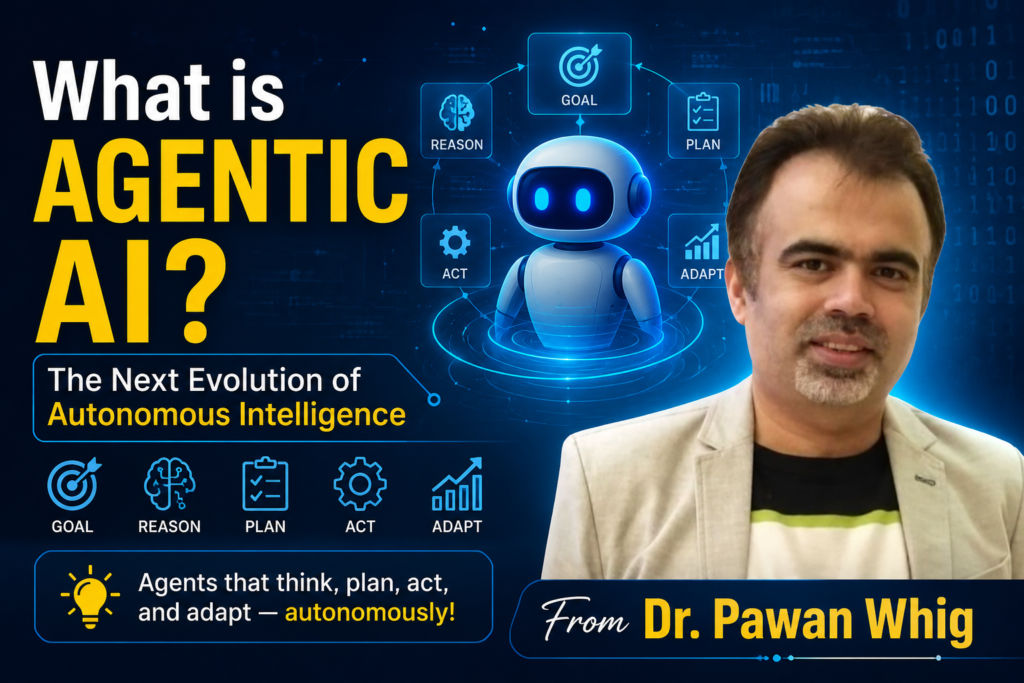
What is Agentic AI?
Agentic AI refers to artificial intelligence systems that can act autonomously to achieve goals, rather than simply responding to prompts. These systems can perceive information, reason, plan, make decisions, use tools, and execute tasks with minimal human intervention.
In simple terms:
- Traditional AI answers questions.
- Agentic AI takes actions to accomplish objectives.
Key Characteristics of Agentic AI
1. Goal-Oriented Behavior
The AI is given a goal and determines the steps needed to achieve it.
Example:
Goal: “Prepare a market analysis report for electric vehicles.”
The agent:
- Collects data from multiple sources
- Analyzes trends
- Creates charts
- Writes the report
- Delivers the final document
2. Autonomous Decision-Making
Agentic systems can choose among multiple actions based on context and objectives.
3. Planning and Reasoning
They break complex tasks into smaller subtasks and execute them in sequence.
4. Tool Usage
They can interact with:
- Search engines
- Databases
- APIs
- Software applications
- Business systems
5. Memory and Learning
Advanced agents maintain context and remember previous interactions to improve future decisions.
Evolution of AI
| Generation | Capability |
|---|---|
| Rule-Based Systems | Follow predefined rules |
| Machine Learning | Learn patterns from data |
| Generative AI | Generate text, images, code |
| Agentic AI | Plan, reason, and act autonomously |
| Autonomous Multi-Agent Ecosystems | Multiple AI agents collaborate toward complex goals |
Agentic AI Architecture


A typical Agentic AI system contains:
- Perception Layer
- Collects data from users, sensors, APIs, and databases.
- Reasoning Engine
- Understands the problem and evaluates options.
- Planning Module
- Creates a sequence of actions.
- Execution Layer
- Uses tools and software to perform tasks.
- Memory Layer
- Stores short-term and long-term knowledge.
- Feedback Loop
- Monitors results and adjusts actions.
Real-World Examples
Software Development
An AI agent can:
- Gather requirements
- Generate code
- Run tests
- Fix bugs
- Deploy applications
Customer Support
Agents can:
- Understand customer issues
- Search knowledge bases
- Resolve problems automatically
- Escalate complex cases
Healthcare
Agents can:
- Analyze patient records
- Recommend treatments
- Schedule follow-ups
- Monitor outcomes
Finance
Agents can:
- Track markets
- Generate investment insights
- Detect fraud
- Automate reporting
Multi-Agent Systems
In advanced environments, multiple agents collaborate.
Example:
- Research Agent → Collects information
- Analysis Agent → Processes data
- Writing Agent → Creates reports
- Review Agent → Validates output
- Publishing Agent → Distributes content
Together they form an autonomous digital ecosystem.
Benefits
✅ Increased productivity
✅ Automation of complex workflows
✅ Faster decision-making
✅ Continuous operation (24×7)
✅ Reduced operational costs
✅ Enhanced scalability
Challenges
⚠️ Security and privacy risks
⚠️ Hallucinations and incorrect decisions
⚠️ Ethical and governance concerns
⚠️ Lack of transparency in decision-making
⚠️ Regulatory compliance requirements
Future of Agentic AI
The future is moving toward Autonomous Digital Ecosystems, where AI agents collaborate with humans and other AI systems to manage businesses, research, healthcare, education, smart cities, and industrial operations with minimal human supervision.
Many experts view Agentic AI as the next major evolution beyond Generative AI, enabling organizations to move from AI-assisted work to AI-executed work.
One-Line Definition
Agentic AI is an AI system capable of perceiving, reasoning, planning, and autonomously taking actions to achieve specified goals while adapting to changing environments.